History of Minneapolis College

A Century of Minneapolis College
Minneapolis College has more than a century of history in downtown Minneapolis. Our story brings together a technical education tradition dating to 1914 and a community college founded in 1965, which merged in 1996 to create the college we know today.
Minneapolis Technical College
Minneapolis Technical College traces its roots to the Girls Vocational School, founded on December 14, 1914, by Miss Elizabeth Fish, a teacher who served as the school’s first principal. The school opened that fall with eight women instructors, 93 students, and a commitment to train students for their chosen fields. In 1915, the school moved into the southern portion of old Central High, Minneapolis’s first high school. The southern portion of the building was at that time occupied by the William Hood Dunwoody Industrial Institute (also founded in 1914), which provided training for boys. Two years later Dunwoody Institute (now Dunwoody College) moved to its present location, at Lyndale and Hennepin Avenues, and the Girls Vocational School expanded into the vacated space.
In the decades that followed, the vocational school moved to 1101 Third Avenue South, began to also enroll young men, phased out its high school component, and offered exclusively postsecondary and extension classes. The school also went through a series of name changes. It entered the 1980s as Minneapolis Technical Institute (MTI), on a new 418,000-square-foot campus at 1415 Hennepin Avenue—currently the site of the “T” Building. MTI finished the decade with a 75th anniversary celebration and a name change to Minneapolis Technical College.
Minneapolis Community College
Minneapolis Community College was first known as Metropolitan State Junior College (MSJC). When it opened in 1965, MSJC’s 60 students attended classes on the first floor of Minneapolis Central High School.
In 1967, MSJC moved into four buildings on the campus of Northwest Bible School, on Loring Park in downtown Minneapolis – our current campus location. In 1974, the college was renamed Metropolitan Community College, and in 1976 it entered into a cooperative agreement with Minneapolis Public Schools to share a site with Minneapolis Technical Institute.
In 1977 a long-term plan for campus construction was approved, and in 1978 Metropolitan Community College moved into the “C” building at 1501 Hennepin Avenue – renamed Kopp Hall in 2004. In 1979 the College became Minneapolis Community College (MCC). Five years later MCC moved its library to the Basilica of St. Mary and began construction of a new classroom building, the Philip C. Helland Center. MCC’s “D” building (renamed Bowman Hall in 2004) and Irene H. Whitney Fine Arts Center rounded out building construction on campus during the 1980s.
Minneapolis Community and Technical College
In 1991 the Minnesota Legislature passed a law merging Minnesota’s public community colleges, technical colleges, and state universities, effective July 1, 1995. Minneapolis Community College and Minneapolis Technical College thereby became part of the new Minnesota State Colleges and Universities (MnSCU) system.
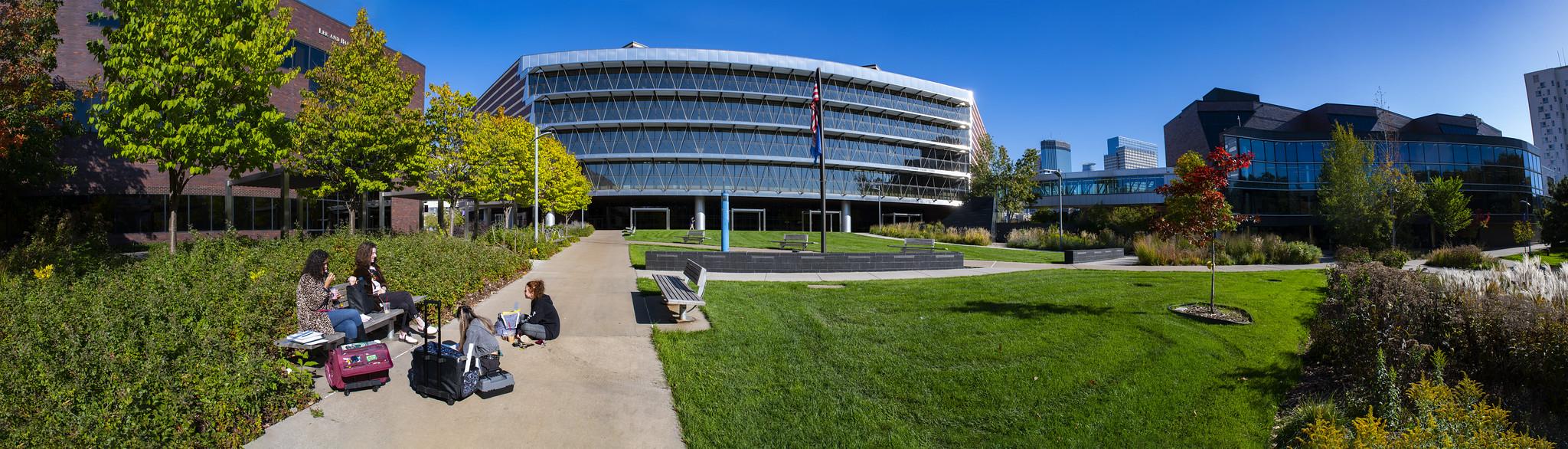
In February 1996, Minneapolis Community College and Minneapolis Technical College merged to become Minneapolis Community and Technical College (MCTC). In December 1996, the Wells Family Center officially became part of the college campus. In 2003 MCTC dedicated its new library and third-floor classroom space as Wheelock Whitney Hall. Also in 2003, MCTC acquired land adjacent to the college. The land, previously owned by the Billy Graham Evangelistic Association, is now home to the Management Education Center and the Science Center. In fall 2010 MCTC completed its outdoor plaza, creating a sustainable central green space with native plantings.
In 2014 MCTC completed construction of its Student Center, with student gathering/lounge spaces and office spaces for student life staff and for student clubs/organizations. This construction also provided a new main entry to Helland Center from Loring Park.
The 2016 Comprehensive Facilities Plan identified three primary goals for campus facilities: 1) express and support diversity, 2) support first-year students, and 3) contribute to student success. Student-centric strategies for campus spaces included the following: increase access to student support; improve the arrival and way finding experience; develop schools within the College; provide flexible learning spaces; create an Academic Success Center; establish a high-profile Inclusivity Center; expand the College’s relationship with Metro State University.
Minneapolis College
Between 2016 and the present, progress has been made toward implementing these strategies, including a Student Affairs remodel, which started in 2019; a rebrand with new guidelines that include adopting the name Minneapolis College, a new logo, signage, and messaging; a redesign for Schools within College; campuswide classroom AV upgrades; and a new Academic Success Center.
In 2018 – 2020 Metro State University’s education center and theater program were established and expanded on campus. The Management Education Center’s Capital Project was funded by the state legislature in 2020 – 2023, advancing baccalaureate success for underserved student populations in the Twin Cities metropolitan area.